
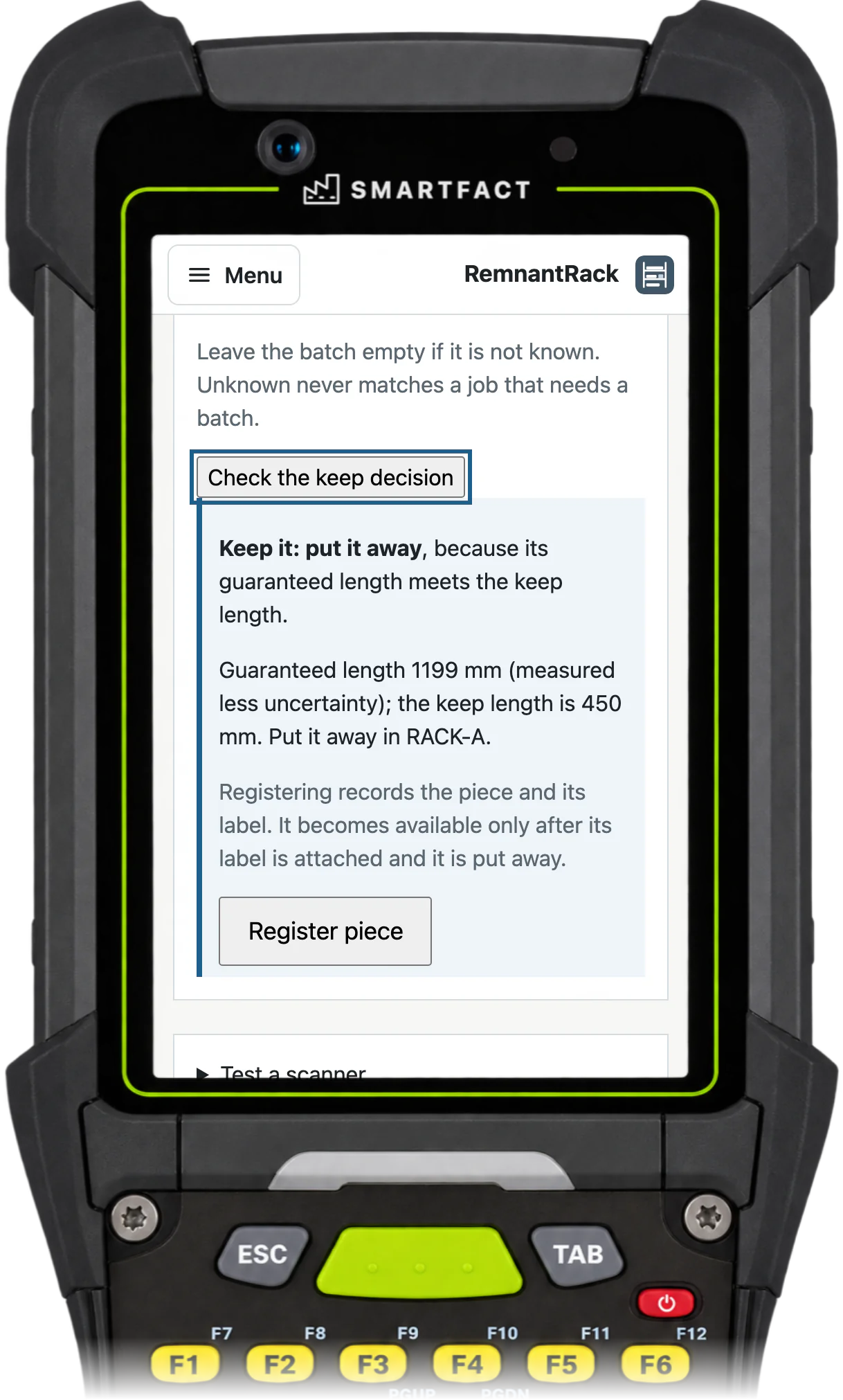
What minimum length should you set?
Start from the shortest part you regularly cut from that material, and add the kerf, trim and processing allowance one cut needs: a piece shorter than that cannot make a part. Some workshops start from a round figure, such as 300 mm for linear bars, and adjust it once they see which pieces get used.
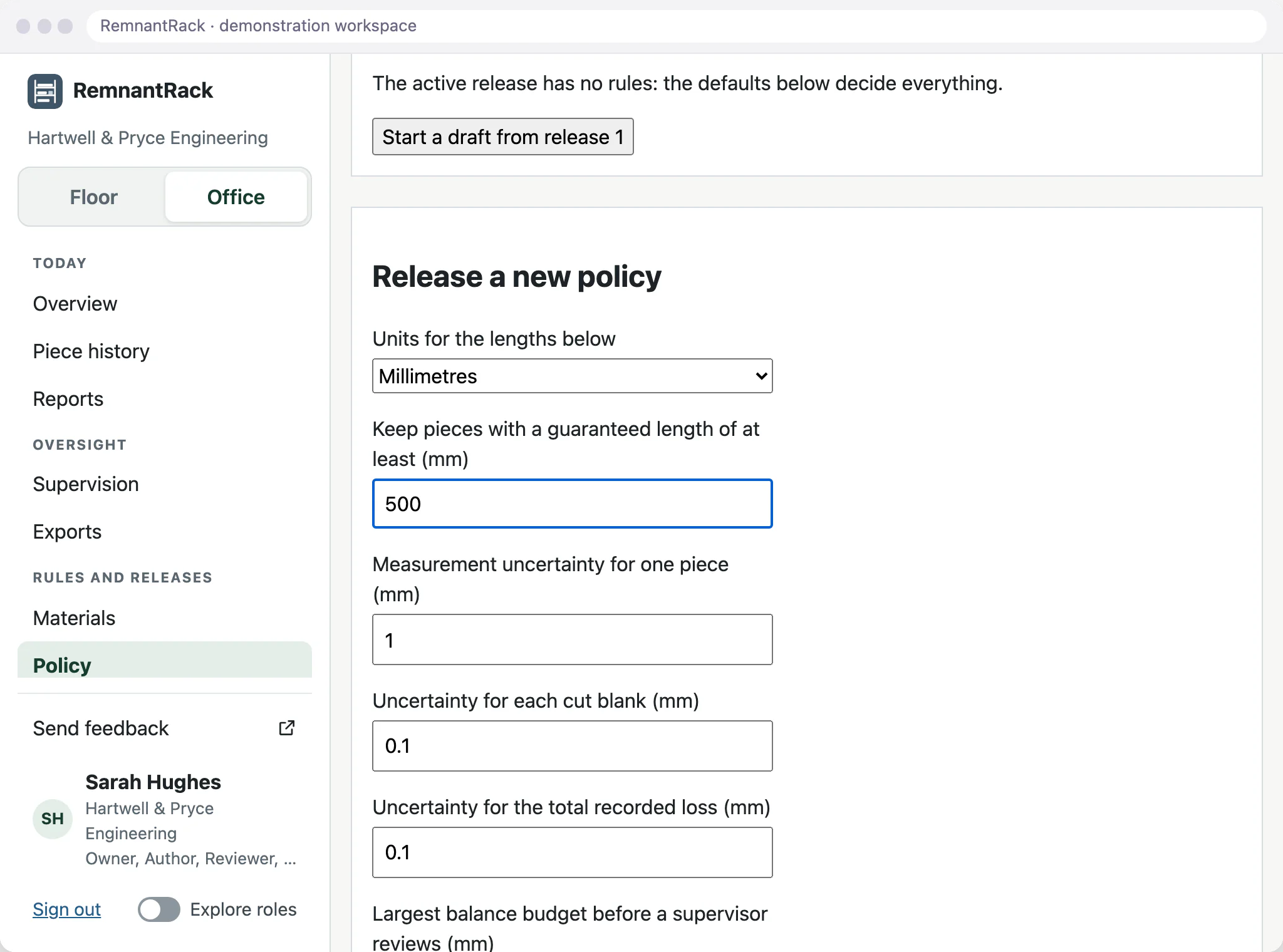
In RemnantRack the keep length is part of your released policy, alongside the measurement uncertainty and cutting allowances. It is compared with each piece's guaranteed length, the measured length less its uncertainty, so a piece measured right at the threshold is kept only when it is certainly long enough. Approved rules can set different keep lengths and racks for different materials.
What happens to a short piece?
A piece whose guaranteed length is below the keep length is registered as waiting for disposal review. Its label reads Disposal review: do not use, and it is never put on a rack or offered to a job.
A supervisor reviews it. They can keep it after all, which gives it a new label and sends it to put-away and is reported for policy review, or decide to dispose of it. Disposal is then confirmed at a station by scanning the piece's label, so nothing leaves the register by a rule alone.
Changing the threshold
Changing the keep length is a policy release. Review the uncertainty and every cutting allowance, record why the policy changes, and release it with a recent second-factor check.
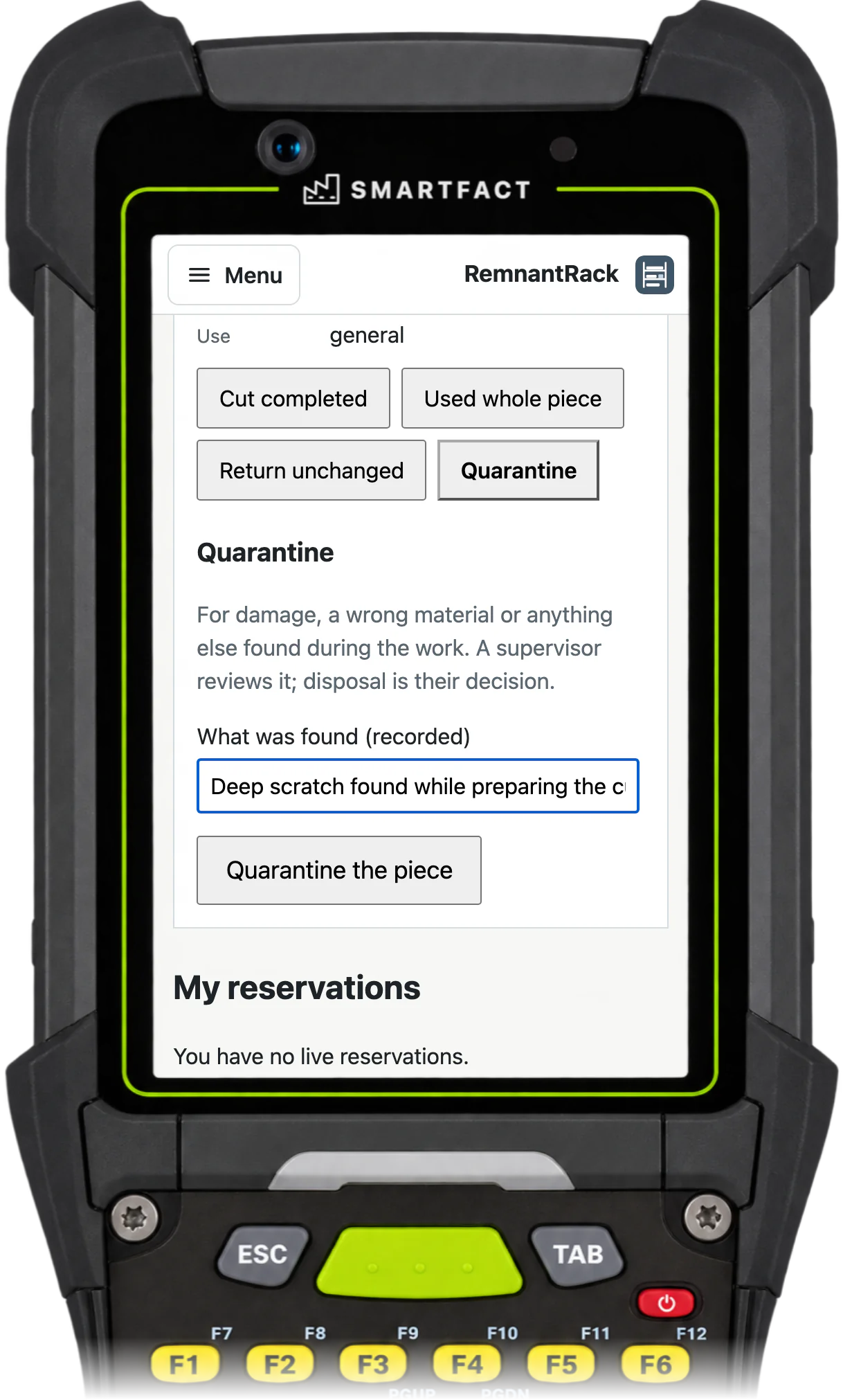
The released values apply to new work. Work already checked out keeps the policy it started with, and reservations made under the previous policy end, so their pieces are checked at their bins before they are offered again.
Damaged or doubtful pieces
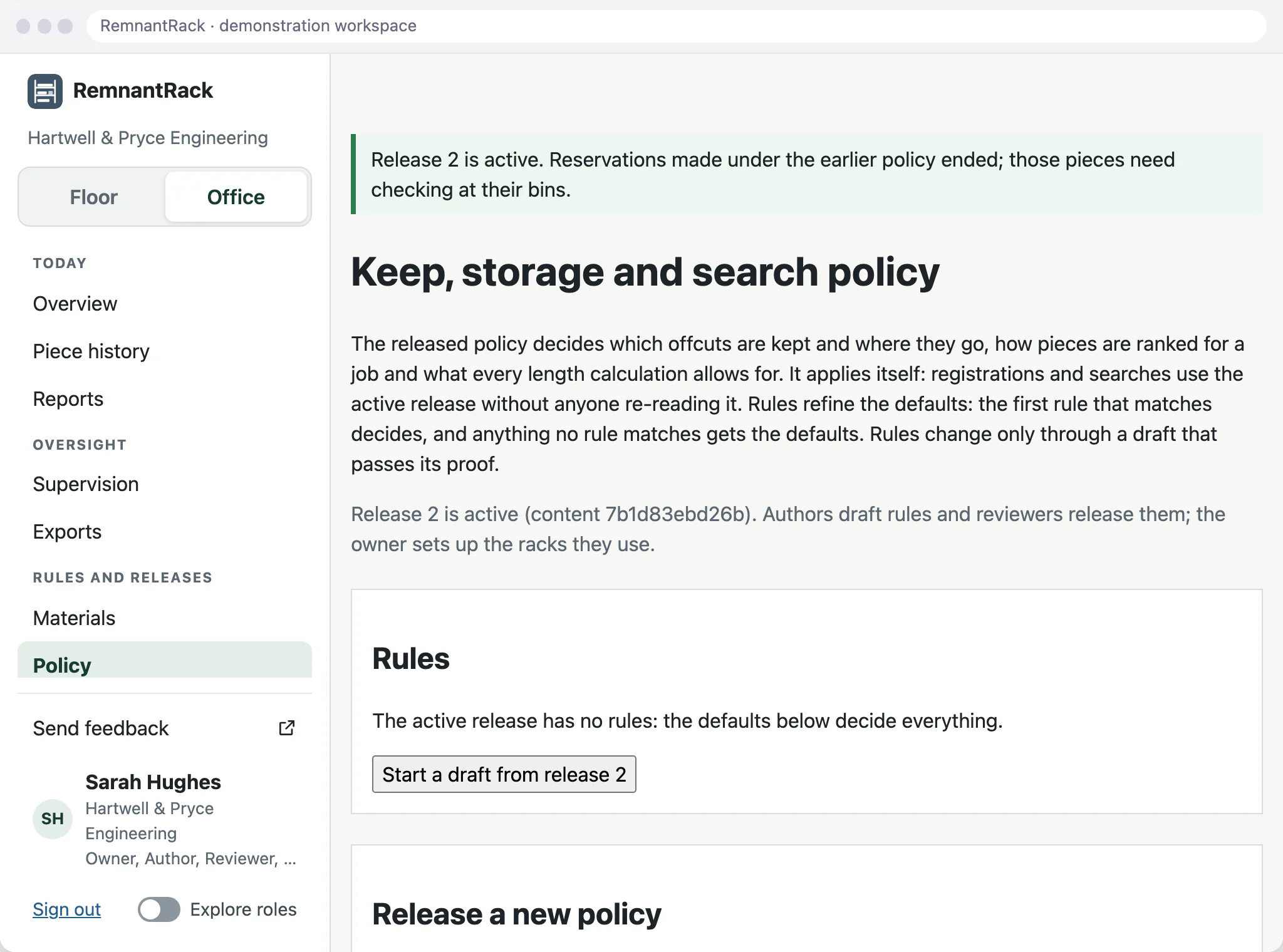
A piece recorded as damaged, or of unknown condition, is quarantined at registration whatever its length. An operator can also quarantine a piece when damage, a wrong material or anything else turns up during the work, describing what was found.
Quarantine keeps the piece out of available stock while a supervisor investigates. It is not permission to dispose of it.
What RemnantRack does not do
- Disposal decisions. A supervisor decides disposal, and a person confirms it at the rack.
- Grading or certifying material. A rule cannot certify a grade or approve a substitute material.
- Sheets, panels or irregular shapes. The keep length applies to straight lengths.
Common questions
How do we measure and enter lengths?
Measure the usable straight length and enter it in millimetres or inches, with the measurement uncertainty of your usual method. RemnantRack converts both exactly and never rounds a length to make a match. Kerf, trim and processing allowances come from your policy, can be changed for each job and are shown in every search.
Can different materials have different keep lengths?
Yes. Approved rules can keep one material from one length and another from a different one, and send long pieces to their own rack, for example keeping A17 aluminium lengths from 450 mm upwards and putting pieces over 2 metres in a long rack. Your team tests the rules against examples before releasing them.
Early access starts with an agreed workflow. Supported scope and onboarding arrangements are confirmed with you.


